
Order-to-cash BPMN diagram example
Order-to-cash (O2C) is the process from a customer placing an order to the business collecting payment. It's one of the most commonly modelled processes because it crosses sales, fulfilment and finance. Here's how it maps to BPMN 2.0.
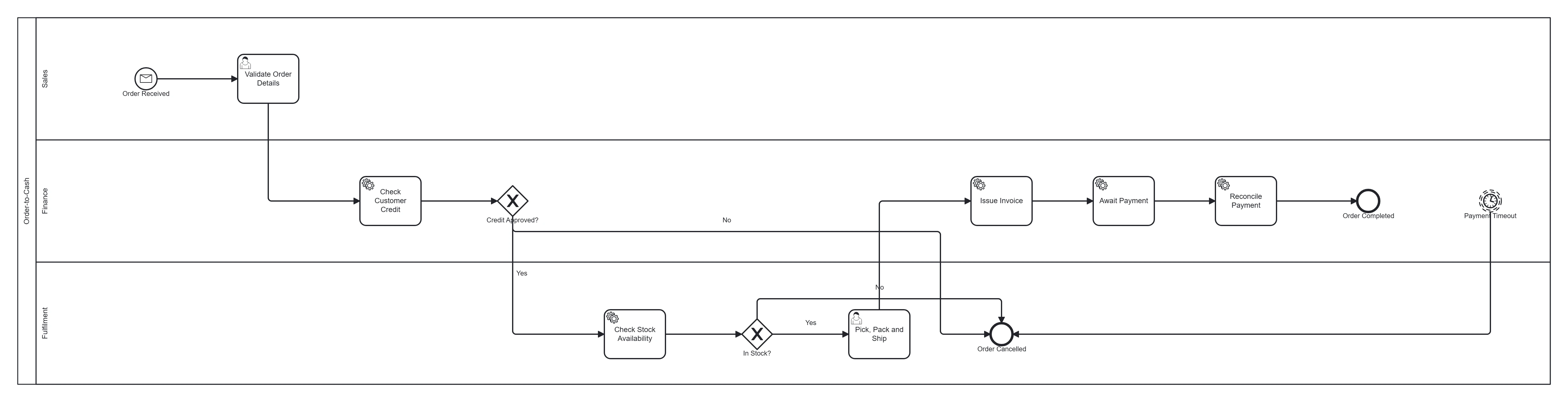
Take this diagram with you. The BPMN 2.0 XML below is the exact source behind the diagram above — open it in Camunda Modeler, Flowable, Activiti, bpmn.io, or any BPMN 2.0 tool.
↓ Download Order-to-cash .bpmnOpen in BPMN Studio
Free, no sign-up, no attribution required.
The process in plain English
An order arrives. The business validates it, checks the customer's credit and stock availability, fulfils the order, issues an invoice, and reconciles payment. If credit fails or stock is unavailable, the order is cancelled or held.
Steps and their BPMN elements
The middle column names each BPMN element; the BPMN symbols and shapes reference shows what each one looks like.
| Step | BPMN element | Lane |
|---|---|---|
| Order received | Message start event | Sales |
| Validate order details | User task | Sales |
| Credit approved? | Exclusive gateway | Finance |
| Check stock availability | Service task | Fulfilment |
| In stock? | Exclusive gateway | Fulfilment |
| Pick, pack and ship | User task | Fulfilment |
| Issue invoice | Service task | Finance |
| Await payment (24h timeout) | Timer boundary event | Finance |
| Reconcile payment | Service task | Finance |
| Order completed | End event | — |
| Order cancelled | End event | — |
Key decision points
- Credit approved? — an exclusive gateway; the "no" branch routes to cancellation.
- In stock? — routes to fulfilment or to a back-order/hold path.
- Payment timeout — a timer boundary event on "Await payment" cancels or escalates unpaid orders.
Common variations
- Add a parallel gateway to invoice and ship simultaneously.
- Add an approval user task for large orders.
- Split into two pools (Customer and Company) with message flows if you're modelling the interaction.
Generate your own order-to-cash diagram
Describe your exact O2C variant — your credit rules, your fulfilment steps — to BPMN Studio and get an editable BPMN 2.0 diagram in seconds, then export it for Camunda or Flowable. Browse more templates or learn how to create a BPMN diagram.
Frequently asked questions
What is the order-to-cash process?
Order-to-cash (O2C) is the end-to-end business process from receiving a customer order through to collecting payment. It typically covers order capture, credit/availability checks, fulfilment, invoicing, and payment reconciliation.
What BPMN elements does an order-to-cash diagram use?
A message start event (order received), user and service tasks (validate order, check credit, ship goods, issue invoice), exclusive gateways (credit approved? in stock?), a timer boundary event for payment timeout, and end events for completed and cancelled orders.